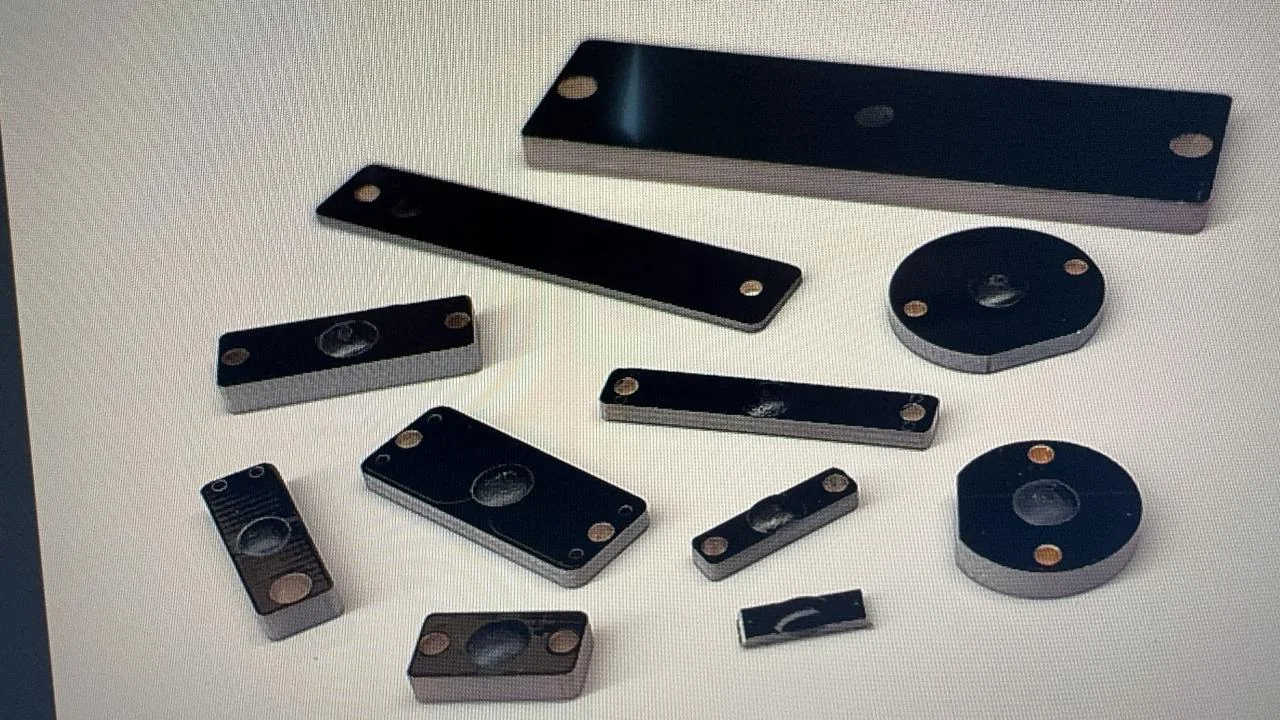
On-metal RFID tags are designed for assets whose metal surface would detune or weaken an ordinary passive inlay. Selection must consider the actual surface, curvature, attachment, temperature, impact, cleaning, reader, antenna and required read behaviour. Swedish Technology can compare suitable tag categories, arrange representative samples and define an acceptance test before a larger on-metal tag purchase.
Swedish Technology connects on-metal RFID tag selection to material evidence, identity ownership, integration and support.
What problem does this solve?
A general-purpose label may read in free air and fail when fixed to steel or aluminium.
Mounting method, clearance, curvature and paint can change the installed result.
A maximum range claim does not describe performance on the real asset and orientation.
How the solution works
Classify material and installation conditions before selecting a tag.
Test several constructions on representative assets with the intended reader and antenna.
Record read probability, orientation, durability, replacement and encoding requirements.
- 1Classify Confirm the asset, environment, process and on-metal RFID tag selection requirement.
- 2Sample Test representative materials, attachment methods, users, readers and exceptions.
- 3Select Choose a preliminary category and record assumptions, evidence and limitations.
- 4Pilot Run the real process with identity, integration and acceptance controls.
- 5Operate Handover standards, replacement, monitoring, support and lifecycle ownership.
Reference architecture
The reference architecture for On-Metal RFID Tags for Tools, Cabinets and Equipment separates asset identity, physical tag or gate behaviour, event processing, system integration and lifecycle controls.
| Layer | What it contains |
|---|---|
| Asset layer | Material, process, attachment, exposure, users and operating conditions. |
| RFID layer | Tag, reader, antenna, printer, gate, handheld or portal selected for the use case. |
| Identity and event layer | Encoding, validation, filtering, confidence, exceptions and reconciliation. |
| Operations layer | Security, maintenance, replacement, support, analytics and change control. |
Deployment options: Deploy on-premise, edge or UAE-region private cloud according to data residency, connectivity, security and operating requirements.
Key capabilities
Integrations
The physical selection must remain connected to identity, event, business and support ownership; a readable tag alone does not prove a valid transaction.
| System | Integration point & data exchanged | Direction |
|---|---|---|
| ERP/WMS/EAM | Link identity and validated events to the business system of record. → RFID Tag Directory and Selection Guide | bi-directional |
| Middleware/API | Control encoding, observations, exceptions and reconciliation. → RFID for Metal Assets: Tag Selection and Read Accuracy | bi-directional |
| GIS/BI | Report asset status, quality, failure and lifecycle evidence. → RFID Product Selector: Tags, Readers, Gates and Integrations | bi-directional |
Industry use cases
Industrial tools
Identify tools and equipment through stores and work areas.
Facilities
Track cabinets, plant and maintenance assets.
Government stores
Create durable identity for metal inventory and equipment.
UAE & GCC considerations
For UAE and GCC projects, confirm regional radio configuration, data residency, Arabic/English operations, network segmentation, local support, procurement evidence and handover obligations before final selection.
Implementation approach
- 1Classify Confirm the asset, environment, process and on-metal RFID tag selection requirement.
- 2Sample Test representative materials, attachment methods, users, readers and exceptions.
- 3Select Choose a preliminary category and record assumptions, evidence and limitations.
- 4Pilot Run the real process with identity, integration and acceptance controls.
- 5Operate Handover standards, replacement, monitoring, support and lifecycle ownership.
Security & deployment
Use least-privilege accounts, segmented device networks, protected credentials, auditable changes and controlled configuration backups. Keep identity, replacement and exception records available to the operating owner.
Limitations & prerequisites
- A tag or gate catalogue cannot replace a representative installed test.
- Read behaviour depends on material, orientation, process, reader, antenna and environment.
- Vendor model status, regional availability and firmware must be checked before quotation.
- A readable identifier does not prove a correct business record until identity and integration rules are validated.
Selection view for On-Metal RFID Tags for Tools, Cabinets and Equipment
The correct choice depends on the asset, operating environment and lifecycle—not on one headline specification.
| Decision | Starting point | Validation needed |
|---|---|---|
| Asset or zone | Classify material and process | Representative sample |
| RF behaviour | Choose a preliminary category | Installed read test |
| Identity | Define creation and replacement owner | Reconciliation test |
| Commercial step | Preliminary recommendation | PoC, BoQ or quotation |
Treat every recommendation as preliminary until assumptions and evidence are reviewed together.
FAQ
Usually; on-metal constructions are designed to preserve coupling near the target surface.
No. Surface, mounting, frequency, tag construction and environment require validation.
Actual material, location, attachment, orientation, reader, antenna, distance and movement case.
It can affect spacing, durability and installation; test the complete mounting method.
Test the tag on the actual curvature and attachment location rather than a flat proxy.
Often, but the process must link encoded identity to the asset record and handle replacement.
Need help selecting or deploying RFID?
Share the asset, process, site and target systems. We will identify the evidence needed for samples, survey, PoC, BoQ or quotation.
Request an RFID AssessmentRFID Asset Management System
Swedish Technology supplies the complete RFID stack — UHF tags, handheld and fixed readers, gates, antennas, printers and the asset management platform — with the integration and RF engineering behind it.
Request RFID Solution PricingSources & evidence
- HID IronTag — Official on-metal tag reference.
- Xerafy PICO — Official industrial tag reference.
- GS1 RFID UHF air interface — Standards context for UHF RFID.
Vendor and product names are trademarks of their respective owners; references are for technical context and do not imply partnership, certification or endorsement unless stated on the vendor's official pages.