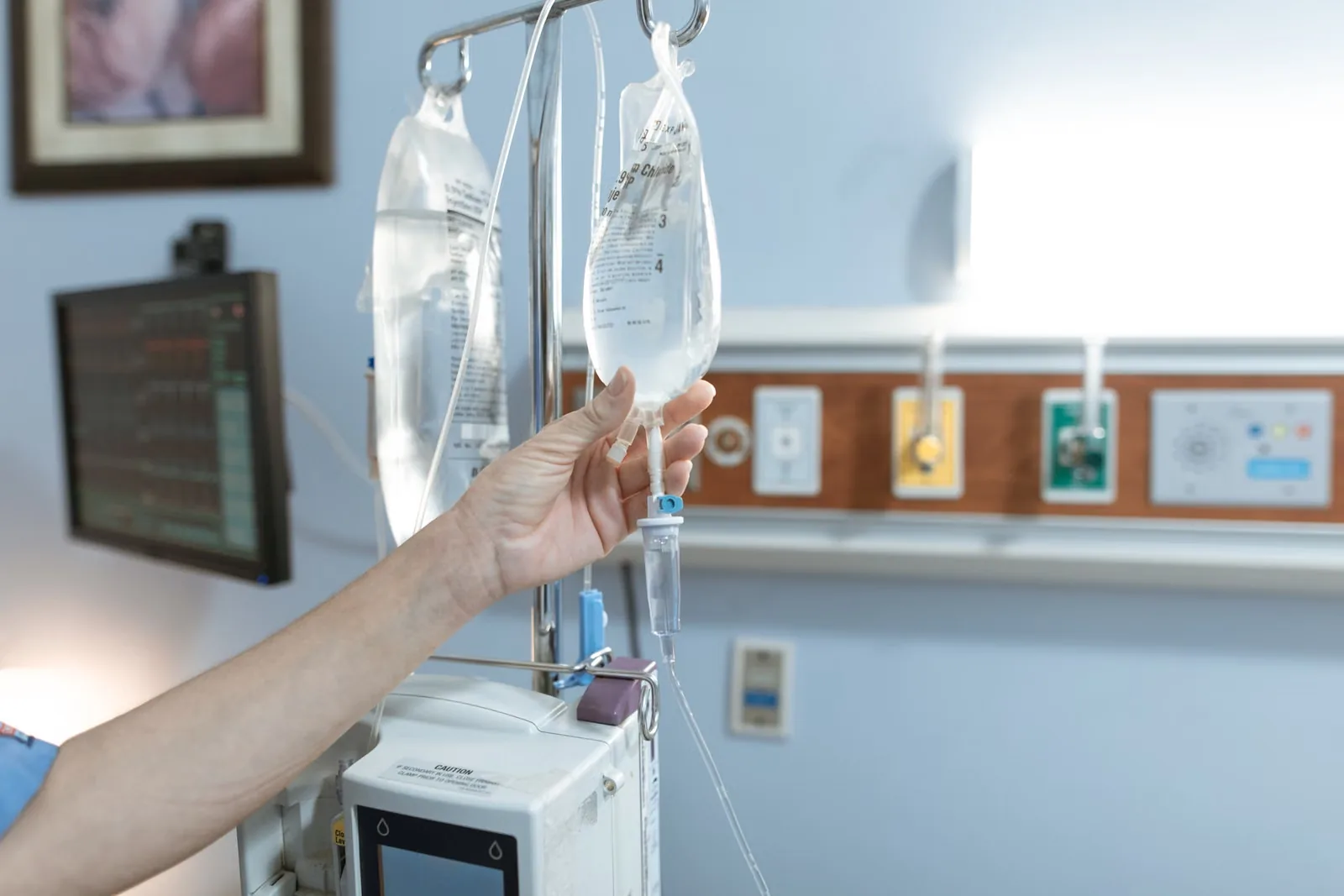
Hospital asset tracking uses tags on mobile medical equipment and readers across the facility to show where each item is, how much it is used, whether it is clean or awaiting decontamination, and whether its maintenance is current. It is used to reduce search time, avoid unnecessary purchases and rentals, and prove that equipment servicing and recalls have been managed.
Most hospitals do not have an equipment shortage. They have a findability problem that behaves exactly like one — and gets solved by buying more.
- Locate equipment to the room or zone in seconds
- Real utilisation data instead of assumed shortage
- Maintenance and recall compliance you can evidence
- Clean and awaiting-decontamination status tracked

Hoarding is a rational response to an unreliable supply
Ask a nursing team why an infusion pump is in a cupboard behind the linen and the honest answer is that last time they needed one urgently there were none. Hoarding on wards is not misconduct; it is a correct individual response to a system that cannot promise equipment when it is needed. It is also self-reinforcing: every hidden pump makes the central pool less reliable, which produces more hiding, and the hospital reads the resulting shortage as a reason to purchase.
Around that sits a set of problems that cost more than the equipment. Biomedical engineering cannot complete planned maintenance because it cannot find the devices, so servicing compliance slips on paper as well as in practice. A safety notice or recall requires locating every affected unit, which becomes a manual sweep of the building. Rental equipment stays on hire long after it stopped being used, on a charge nobody is watching. And nobody knows real utilisation, so purchasing decisions are made from anecdote.
- Ward hoarding is rational, self-reinforcing, and read by management as a shortage.
- Nursing time spent searching is clinical time, and it is never measured.
- Planned maintenance slips because engineering cannot locate devices.
- Recalls and safety notices require a manual sweep of the whole facility.
- Rental equipment accrues charges after it has stopped being used.
Solution overview
Swedish Technology deploys location tracking with a specific sequence in mind: visibility first, then a service promise, then the hoarding stops. Tags on mobile equipment and readers across the facility show where each item is to the room or zone, so a nurse finds a pump in seconds and a porter delivers rather than searches. That alone does not end hoarding — the ward has to believe equipment will arrive when asked, which is an operational commitment the data makes possible rather than one the technology creates.
The uses that justify the investment are often not the ones in the business case. Decontamination status turns a shared cupboard into a managed pool, because clean and used equipment stop looking identical. Maintenance becomes achievable, so servicing compliance is evidenced rather than asserted at inspection. A recall becomes a query instead of a sweep. And after a few months of real utilisation data, the next purchase or rental decision is made from measurement — which is usually where the money actually is.
How the solution works
- 1Decide what is worth tracking Tag the equipment that moves, is shared and causes delay when missing — pumps, wheelchairs, telemetry, ultrasound, beds. Tagging everything raises cost without raising value.
- 2Choose accuracy per use, not per hospital Zone-level is enough to find a wheelchair; room-level is needed for decontamination and maintenance workflows. Accuracy drives cost more than any other decision, so it is made use by use.
- 3Deploy tags and reader infrastructure Battery tags, passive RFID or a hybrid, with readers or gateways positioned from an RF survey rather than a floor plan — hospitals are full of metal and liquid, both of which defeat assumptions.
- 4Attach status to location Clean, in use, awaiting decontamination, out of service, maintenance due. Location without status tells you where a pump is but not whether you may use it.
- 5Put it where the work happens Search from a ward workstation or a phone, requests routed to porters, and engineering worklists that show where each device is now rather than where it was assigned.
- 6Measure and act Utilisation by device class and ward, feeding purchase, rental and pooling decisions — which is where the return usually comes from.
Key capabilities
Reference architecture
The technology choice is subordinate to the accuracy requirement, and the accuracy requirement comes from the workflow. Deciding in that order is what keeps the project affordable.
Deployment options: Commonly on-premise or private cloud alongside other clinical systems. Location data is retained at the resolution the workflow needs and no longer than it is used.
Hardware options
The one section where the trade-offs deserve to be stated plainly, because this is where an RTLS project succeeds or becomes expensive.
| Device | Where it is used | Selection notes |
|---|---|---|
| BLE asset tags | Mobile equipment: pumps, wheelchairs, telemetry, ultrasound | The practical default. Zone-level accuracy, multi-year battery life, moderate tag cost. Battery replacement across thousands of tags is a real programme, not a footnote. |
| Passive RFID tags | High-volume, lower-value items and choke-point tracking | Very low tag cost with no battery, but requires the item to pass a reader. Excellent for doorway and store-room events, not for continuous location. |
| Infrared or hybrid tags | Where true room-level certainty is required | Infrared does not pass through walls, which is exactly why it gives room-level certainty that RF cannot. Higher cost and more infrastructure. |
| Gateways and readers | Corridors, rooms, store rooms, doorways | Density determines accuracy and dominates cost. Placement must come from an RF survey — hospitals are full of metal, liquid and shielding that break floor-plan assumptions. |
| Handheld reader | Biomedical engineering, store management | For pinpointing a device in a cluttered room, verifying inventory and locating a tag that has stopped reporting. |
Swedish Technology supplies and integrates RTLS hardware from established manufacturers, specified from a site RF survey rather than from a floor plan.
AI capabilities
Applied to patterns across thousands of location events that nobody has time to review.
- Utilisation modelling — Separates genuine use from movement and storage, so utilisation figures reflect clinical use rather than a device being wheeled between rooms.
- Shortage prediction — Forecasts where a device class will fall below par level before it does, which is what makes the central pool trustworthy enough to change ward behaviour.
- Anomaly detection — Flags devices that have stopped moving, left their expected area or gone silent — the early signals of a lost tag, a hidden asset or a device removed from service without a record.
- Purchase and rental modelling — Estimates whether measured demand justifies buying, renting or redistributing, replacing the anecdotal case that usually drives the decision.
Integrations
These can be designed within project scope.
| System | Integration point & data exchanged | Direction |
|---|---|---|
| CMMS and biomedical asset systems | Device register, service history and maintenance schedules, with current location added to the engineering worklist so planned maintenance can actually be done. → RFID Asset Management & Tracking | bi-directional |
| ERP and procurement | Asset records, depreciation and purchase decisions informed by measured utilisation rather than by requests. → Oracle E-Business Suite | bi-directional |
| Hospital information systems | Ward and bed context to interpret utilisation, at the minimum scope required — not a clinical data feed. | inbound |
| Decontamination and sterile services | Clean and dirty status synchronised so equipment in a shared cupboard is not ambiguous. | bi-directional |
| Porter and task management | Equipment requests routed to porters with the current location attached, turning a search into a delivery. | outbound |
| Facility and building systems | Shared gateway infrastructure and zone definitions with other building services where present, avoiding a second overlapping network. → Facility Management | bi-directional |
The integrations above are designed and implemented within project scope using vendor APIs, webhooks or standard connectors. They do not imply partnership, certification or endorsement by the system owner unless stated on that vendor's official pages.
Dashboards & analytics
- Find equipment — The everyday view: search by type or asset number, see location and status, request delivery.
- Utilisation — Usage by device class, ward and period, with idle and under-used equipment identified.
- Maintenance and compliance — Devices due or overdue for service with current location, and evidence of completed maintenance.
- Par levels and shortfalls — Availability against agreed minimums per ward, which is the number that determines whether hoarding stops.
Security & deployment
This system tracks equipment, and it should be designed so it cannot quietly become a system that tracks people. Tags go on devices, not on staff; where a device is associated with a room it is not associated with the clinician using it; and location history is retained at the resolution the workflow needs rather than the maximum the hardware can produce. That boundary should be written into the deployment rather than assumed, because the infrastructure that locates a pump could locate a badge, and the difference between the two systems is a decision rather than a technical limit. Location data continues to be collected locally during a network interruption and reconciles afterwards.
Data privacy
Equipment location becomes personal data as soon as it can be linked to a person — a device in a single-occupancy room at a known time says something about both the patient and the staff member. We keep the asset register separate from clinical data, avoid associating devices with named clinicians, and aggregate utilisation reporting so it describes wards and device classes rather than individuals.
The staff-monitoring concern deserves to be addressed directly rather than dismissed, because nursing teams raise it immediately and are right to. An RTLS deployment that is quietly used to assess individual staff movement will lose the cooperation the system depends on, and will do so permanently. Under UAE Federal Decree-Law No. 45 of 2021 and the health-sector requirements of the Department of Health – Abu Dhabi and the Dubai Health Authority, the purpose of processing should be stated and adhered to — which here means committing in writing that this is an equipment system.
Industry use cases
UAE & GCC considerations
UAE hospitals tend to be well equipped and recently built, which shifts the value away from 'we need more devices' and toward 'we cannot find or evidence the devices we have'. The strongest cases here are usually maintenance compliance and recall response — both of which come under scrutiny from the Department of Health – Abu Dhabi, the Dubai Health Authority or the Ministry of Health and Prevention depending on the facility, and from international accreditation bodies where a hospital holds that accreditation.
Two practical points. Hospitals here frequently occupy large modern buildings with significant steel and dense services, which affects RF propagation more than teams expect — an RF survey is not a formality. And many facilities are part of groups operating several sites in different emirates, where the useful comparison is between hospitals rather than within one, so the data model should support that from the start rather than being retrofitted.
Implementation approach
- 1Scope by pain, not by asset value Identify which device classes cause delay when missing. That list is usually short and is not the same as the list of most expensive assets.
- 2RF survey Physical survey of the buildings involved. Skipping this is the most common cause of an RTLS deployment that reads well on paper and performs poorly in a ward.
- 3Accuracy decision per use case Zone or room level, technology per asset class, and the cost consequence stated plainly so the choice is made deliberately.
- 4Single ward or department pilot One area, one or two device classes, measured against search time and par-level availability rather than against tag counts.
- 5Service promise Agree what the ward can expect — availability levels and delivery times — because visibility without a promise does not change hoarding behaviour.
- 6Expansion and analytics Further wards and device classes, then utilisation reporting used in a real purchase or rental decision, which is where the business case is proven.
Why Swedish Technology
- We treat ward hoarding as rational behaviour to be answered with a service promise, not as a compliance problem to be reported.
- Accuracy is chosen per use case, because paying room-level cost for wheelchairs is how these projects become unaffordable.
- Deployment follows an RF survey, not a floor plan — hospital construction defeats floor-plan assumptions routinely.
- We put the boundary in writing: this is an equipment system, not a staff-movement system.
- The business case is built on maintenance compliance, recall response and utilisation rather than on theft, because that is where the value actually is.
Limitations & prerequisites
- RF-based location is affected by metal, liquids, shielding and dense building services. Room-level certainty across a whole hospital usually requires infrared or hybrid technology at materially higher cost.
- Battery tags require replacement across a large population; a several-thousand-tag estate is an ongoing programme rather than a one-time deployment.
- Tags can be removed, damaged or fall off, particularly on equipment that is cleaned aggressively. A proportion of assets will always need physical verification.
- Tracking does not by itself end hoarding. Without an operational commitment on availability, wards continue to hold equipment — and become better at hiding it.
- Passive RFID gives event-based location at choke points rather than continuous position, which suits some workflows and not others.
- References to regulatory and accreditation obligations are general guidance, not legal advice.
FAQ
A real-time location system: tags on mobile medical equipment and readers across the facility that show where each item is, at zone or room level, together with its status — in use, clean, awaiting decontamination, maintenance due.
Only if it comes with a service promise. Hoarding is a rational response to unreliable supply, so visibility alone tends to produce better-hidden hoarding. Combined with par levels and a commitment on delivery times, it usually resolves — because the reason for hiding equipment goes away.
Usually both, for different assets. BLE gives continuous zone-level location with multi-year batteries and suits pumps, wheelchairs and telemetry. Passive RFID is very cheap per tag and suits high-volume items tracked at doorways and store rooms. Room-level certainty generally requires infrared or a hybrid.
Zone-level with BLE in a well-surveyed building — which floor and which area, reliably. Room-level with RF is achievable in some layouts and unreliable in others because signals pass through walls. If a workflow genuinely needs room certainty, infrared is the honest answer and it costs more.
Usually not theft. It is maintenance compliance, recall response and utilisation data that changes purchase and rental decisions. Search time reduction is real and valuable, but it is harder to put in a budget submission than a rental line that stops.
The infrastructure could, and we recommend deciding explicitly that it will not. An RTLS project used for staff movement assessment loses clinical cooperation permanently, and that cooperation is what the system depends on.
A safety notice becomes a query — every affected device located, quarantined and recorded — rather than a physical sweep of the building. For hospitals under accreditation, the record of what was removed and when is as valuable as the speed.
It depends on building size and the accuracy required, and the RF survey comes first. A single-department pilot is typically weeks; a full facility with several thousand tags is a phased programme. Tagging is usually faster than the infrastructure work.
Discuss your site with an engineer
Tell us the venue, the expected visitor volume and the systems you already run. We reply with a technical view, a realistic scope and the next sensible step — a site survey, a working demonstration, or a full technical and commercial proposal.
Sources & evidence
- UAE Federal Decree-Law No. 45 of 2021 — Personal Data Protection Law — Governs collection, retention and cross-border transfer of visitor personal data in the UAE.
- Department of Health – Abu Dhabi — Health regulator for Abu Dhabi; medical device and facility standards.
- Dubai Health Authority — Health regulator for Dubai; facility licensing and medical equipment requirements.
Vendor and product names are trademarks of their respective owners; references are for technical context and do not imply partnership, certification or endorsement.