
Smart visitor solutions combine visitor registration, credentialing, access control and analytics into a single platform that records who entered a site, when, through which point and for what purpose. Interactive experience systems — touch walls, AI photo stations, gamified activations, digital concierge — sit on the same platform, so every visitor interaction becomes an engagement record rather than a stand-alone attraction.
Swedish Technology designs both layers together: the visitor record and the visitor experience run on one data model, one consent framework and one integration layer into your ERP, CRM, HR and access-control systems.
- One platform across 17 venue types
- API integration to ERP, CRM, HRMS and access control
- Designed against UAE PDPL from the first workshop
- Arabic and English interfaces, RTL throughout

Why visitor technology is usually bought twice
Most organisations in the UAE end up with two unrelated visitor systems. Security procures a visitor management system to satisfy an access-control or regulatory requirement: it captures an Emirates ID, prints a badge and writes an entry log. Marketing or events separately procures an experience — a touch wall, a photo activation, a game — to make the space engaging. Both work. Neither knows the other exists.
The cost of that split is not the hardware. It is that the organisation can describe visitor volume but not visitor behaviour, and can describe engagement but not who was engaged. The security log knows 4,200 people entered on Tuesday. The activation knows 380 people played a game. Nobody can join those two facts, so nobody can say whether the activation reached the audience it was funded to reach, or which zones the visitors who converted actually walked through.
A second, quieter cost appears at the integration stage. Two suppliers means two data models, two consent mechanisms and two sets of personal data leaving the site. Under UAE Federal Decree-Law No. 45 of 2021, the organisation — not the supplier — is accountable for the lawful basis, the retention period and any cross-border transfer of that data. Reconciling two vendors' privacy positions after installation is considerably harder than specifying one before it.
- Visitor counts exist, but not the journey between entry and exit.
- Engagement is measured by the activation supplier, in their portal, on their retention schedule.
- Contractor, delivery and staff movements sit in a different system from guests and customers.
- Every new venue or event repeats the procurement instead of extending a platform.
- Arabic is retrofitted to an English product rather than designed as a first-class interface.
Solution overview
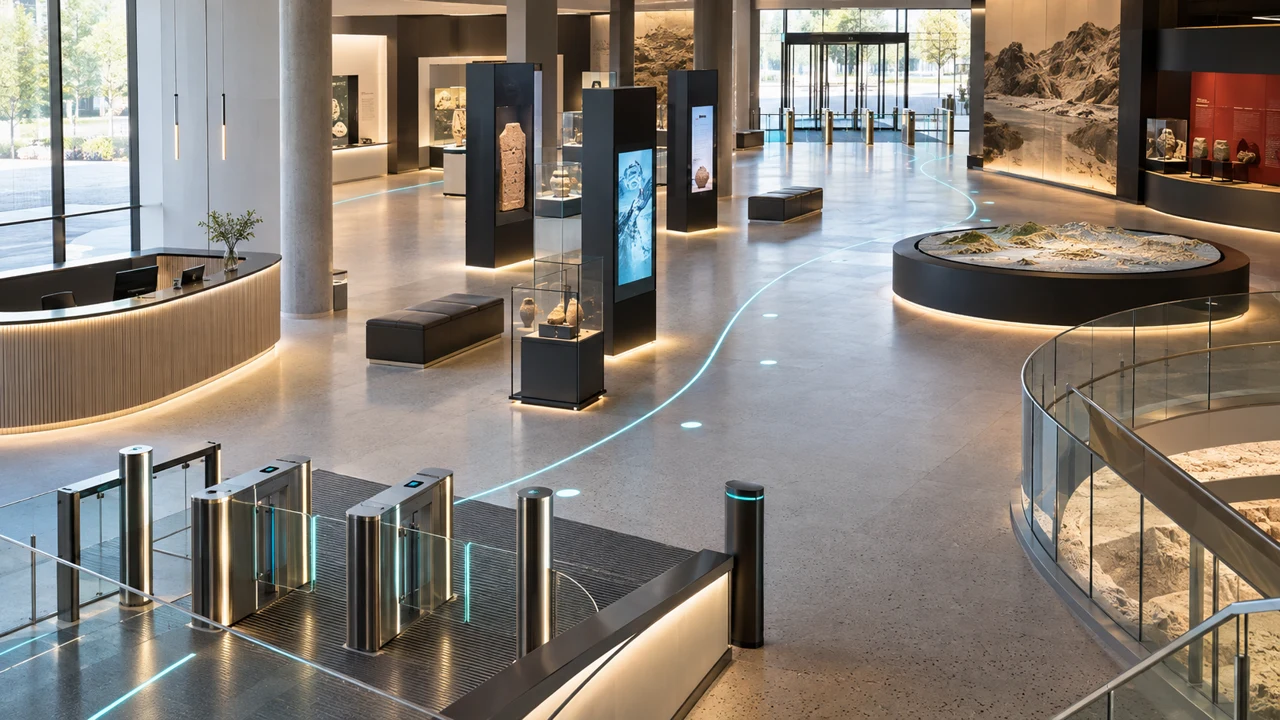
Swedish Technology treats the visitor journey as one system with two visible surfaces. The record surface handles invitation, pre-registration, identity capture, credentialing, access decisions, escorting rules and departure. The experience surface handles everything a visitor actually touches — kiosks, interactive walls, games, photo stations, wayfinding screens, digital concierge. Both write to the same visitor object.
Because it is one object, a question that normally needs a data project becomes a dashboard filter: which exhibitor stands did the visitors who registered as government buyers actually stop at; how long did residents' contractors remain on site against the permit they were issued; which wing of the hospital generates the most wayfinding requests at 09:00.
The platform is assembled from components rather than sold as a fixed product. A residential community needs ANPR, resident approval and a delivery workflow, and needs no badge printer. An exhibition organiser needs badge printing at scale, exhibitor lead capture and RFID zone counting, and needs no ANPR. Both are the same platform with a different component set, which is why the second deployment costs materially less than the first.
How the solution works
The sequence below is the common spine. Individual solutions in this cluster change the capture devices and the decision rules, not the shape.
- 1Invitation and pre-registration A host, resident, exhibitor or scheduling system creates an expected-visit record. The visitor receives a link or QR code by SMS, email or WhatsApp and completes their details, documents and consent before arrival.
- 2Identity capture On arrival the visitor is identified at a kiosk, a reception tablet, a gate or a camera. Depending on the site this reads an Emirates ID, a passport by OCR, a pre-issued QR code, an RFID or NFC credential, or a vehicle plate via ANPR.
- 3Verification and decision The platform checks the record against the expected-visit list, watchlists, induction or permit status, insurance validity and any zone restriction, then issues an allow, escort-required or deny decision.
- 4Credential issue A badge is printed, a wristband encoded, a mobile pass issued or an existing access-control card temporarily entitled. The credential carries only what the downstream read points need.
- 5Movement and interaction Read points, cameras and interactive endpoints record movement and engagement — hall entries, zone transitions, stand visits, game plays, kiosk sessions, wayfinding requests — against the same visitor object.
- 6Departure and retention Check-out closes the visit, whether by scan, gate exit, timeout or bulk end-of-day rule. Personal data then follows the retention schedule agreed in the design workshop; aggregate analytics survive it.
- 7Integration and reporting Records flow to the systems that own the follow-up: CRM for leads, ERP or CMMS for contractors, HR for staff, BI for management reporting, GIS for spatial analysis.
Key capabilities
Six capability groups run across every solution in the cluster. Each individual solution page describes how that group is configured for its own environment.

Reference architecture
The reference architecture below is the one every solution in this cluster is cut from. A given project uses a subset: the layers stay, the components inside them change with the venue.
| Layer | What it contains |
|---|---|
| Visitor | The person or vehicle arriving, and the credential they carry — a pre-registration QR code, an Emirates ID, an RFID wristband, a mobile pass or a number plate. |
| Capture & interaction | Every device the visitor meets: self-service kiosks, reception tablets, badge printers, fixed and handheld RFID readers, ANPR cameras, turnstiles, touch walls, motion sensors and photo stations. |
| Edge & gateway | Local controllers that keep gates and kiosks working when the network does not, buffer events until connectivity returns, run computer-vision inference on site where video must not leave the premises, and report device health. |
| Application platform | Registration and expected-visit management, access rule evaluation, credential lifecycle, approval workflows, escorting and permit logic, consent capture and the immutable audit trail. |
| AI engine | Vision models for counting, density, PPE and behaviour; forecasting for queues and peak load; anomaly detection on movement patterns; and Arabic/English language models for search, summarisation and conversational interfaces. |
| Data layer | The visitor object and its event history — identity, visit, movement and engagement — held under an explicit retention schedule that separates personal data from the aggregate analytics that outlive it. |
| Integration & API layer | REST endpoints, outbound webhooks, SSO via SAML or OIDC, directory synchronisation via LDAP or Entra ID, message queues for high-volume event streams, and scheduled file exchange where a legacy system offers nothing else. |
| Systems of record | The systems that own the consequence of a visit: ERP for contractor and supplier data, CRM for leads, HRMS for staff, access control and CCTV for security, CAFM/CMMS for facilities work orders, BMS for building services and GIS for spatial context. |
| Consumption | Live operations dashboards, security command views, scheduled management reporting, threshold alerts to SMS, email or Teams, and resident, staff or exhibitor mobile applications. |
Deployment options: Cloud, on-premise or hybrid. Government and defence-adjacent sites commonly require the data layer and AI inference to remain on-premise inside the customer network, with only aggregate reporting leaving it. Multi-site operators more often run a central platform with edge controllers per venue.
Hardware options
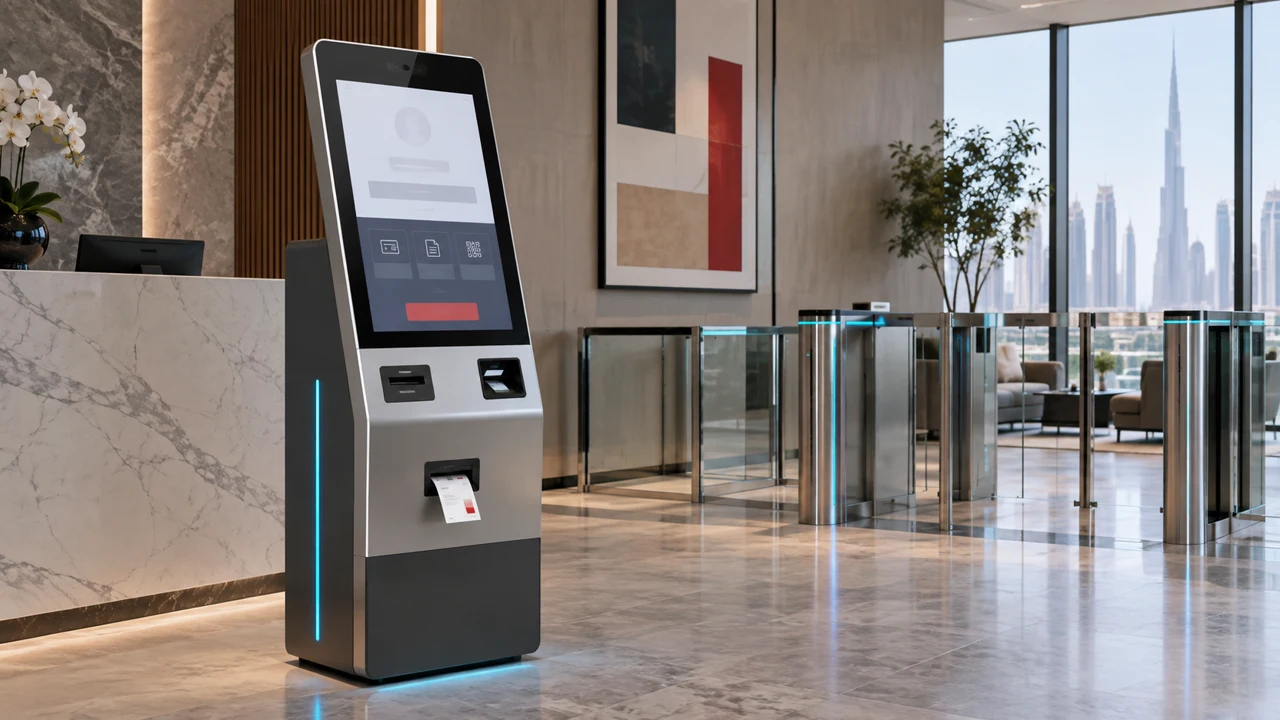
The physical layer is sized to the venue, visitor volume and privacy model. Devices can work locally during a network interruption and reconcile events when the connection returns.
| Device | Where it is used | Selection notes |
|---|---|---|
| Registration kiosks and reception tablets | Entrances, lobbies and service centres | Self-service or assisted capture for QR codes, Emirates ID, passport OCR, consent and appointment check-in. |
| Badge printers, QR and mobile passes | Exhibitions, offices and controlled events | Credential format follows the access-control and evacuation requirements of the site. |
| RFID/NFC, BLE or UWB readers | Gates, zones, rooms and movement choke points | Use RFID for event capture and RTLS technologies where live location or dwell time changes an operational decision. |
| Cameras, ANPR and edge controllers | Vehicle gates, security zones and high-volume approaches | Inference and buffering can remain on-site when video or identity data must stay inside the customer network. |
The final device list is confirmed through a site survey, network review and privacy workshop; the page describes design options rather than a fixed bill of materials.
Software components
| Component | What it does |
|---|---|
| Visitor and expected-visit record | Invitation, pre-registration, walk-up capture, identity attributes, host, purpose, appointment and visit status in one governed object. |
| Rules, approvals and credential lifecycle | Allow, escort or deny decisions; host approvals; induction and permit checks; badge, wristband, mobile pass and temporary-access expiry. |
| Experience and engagement services | Touch walls, kiosks, games, photo stations, digital concierge, wayfinding and lead capture write events back to the visitor record. |
| Movement and analytics engine | Zone counts, dwell, queues, occupancy, engagement events and alerts with role-specific views for operations, security and commercial teams. |
| Integration and API services | REST APIs, webhooks, SSO, directory sync and managed event exchange connect the platform to ERP, CRM, HRMS, access control and BI. |
| Consent, privacy and audit controls | Arabic and English notices, retention rules, least-privilege access, audit history and separation of personal records from aggregate analytics. |

Integrations
Swedish Technology integrates its visitor platform with the systems a customer already operates. The entries below describe integrations that can be designed and built within project scope using documented vendor APIs — they are not claims of a shipped, certified connector, and the effort for each is estimated during the discovery workshop.
| System | Integration point & data exchanged | Direction |
|---|---|---|
| Oracle Fusion / Oracle ERP | Contractor and supplier master data can be read from Oracle so a visiting contractor is validated against a real supplier record, and visit or attendance data returned for service confirmation. Integration is normally designed over Oracle's REST services. → Oracle E-Business Suite | bi-directional |
| SAP S/4HANA / SAP SuccessFactors | Employee and contractor records can be synchronised from SAP so access entitlement follows employment status, with attendance or site-time events returned where a payroll or compliance process needs them. | bi-directional |
| Odoo | Visitor, lead and contractor records can be exchanged with Odoo CRM, HR and Maintenance modules — a common route for mid-market operators already running Odoo. → Octopus WMS | bi-directional |
| Microsoft Entra ID / Active Directory | Staff identity, group membership and host lookup can be sourced from the corporate directory so the platform never maintains a second employee list. Administrator access uses SSO. | inbound |
| Microsoft Power BI | Visitor, movement and engagement datasets can be exposed for Power BI so visitor reporting sits alongside the organisation's other management reporting. | outbound |
| Salesforce / HubSpot / Microsoft Dynamics 365 | Captured leads and qualified visitor records can be posted to the CRM in near real time, with campaign and event attribution preserved. | outbound |
| Access control & CCTV/VMS | Temporary entitlement can be written into an existing access-control system so visitors use the doors already installed, and camera events correlated with visit records for investigation. → RAQEEB – AI Surveillance | bi-directional |
| Esri ArcGIS / ArcGIS Indoors | Venue floor plans and indoor networks can be sourced from ArcGIS for wayfinding and spatial analysis, with occupancy and movement published back as layers. → RASM – Digital Twin | bi-directional |
| CAFM / CMMS / BMS | A contractor arrival can open or progress a work order, and a permit-to-work status can gate site entry. Occupancy can inform HVAC and lighting schedules. → Facility Management | bi-directional |
The integrations above are designed and implemented within project scope using vendor APIs, webhooks or standard connectors. They do not imply partnership, certification or endorsement by the system owner unless stated on that vendor's official pages.

Dashboards & analytics
Four audiences read this data and they need different views. Building one dashboard for all four is the most common reason a visitor platform is installed and then unused.
- Live operations — Current occupancy against declared capacity, open visits, queue lengths, gate and device health, and any access decision awaiting a human.
- Security — Denied and escorted entries, watchlist matches, tailgating and forced-door events, overdue departures and a full audit trail per visitor.
- Commercial — Registration conversion, arrival rates against invitations, zone and stand engagement, dwell distribution, and lead volume and quality by source.
- Management reporting — Period-over-period visitor volume, service levels against target, contractor time on site, incident counts and cost-relevant trends, exported or published to BI.

Security & deployment
Access to the platform is role-based and follows least privilege: a receptionist sees today's expected visitors, a security supervisor sees the audit trail, an exhibitor sees only leads captured on their own stand. Administrator access uses single sign-on against the corporate directory so leavers lose platform access when they lose their account, not when someone remembers to remove them.
Personal data is encrypted in transit and at rest. Identity documents captured at registration — Emirates ID, passport images — are treated as the most sensitive class held: they are commonly stored as a verified attribute plus a masked reference rather than a retained image, and where an image must be retained it is held for a defined and short period.
Deployment is cloud, on-premise or hybrid. For government, defence-adjacent and healthcare sites the usual pattern is on-premise: the application, database and AI inference all sit inside the customer network, and video never leaves it. Multi-venue commercial operators more often prefer a central cloud platform with an edge controller per site so gates and kiosks keep working through a network outage and reconcile when the link returns.
Data privacy
Visitor systems collect personal data by design, so privacy is a design input rather than a compliance review at the end. Under UAE Federal Decree-Law No. 45 of 2021, the organisation operating the site is the controller and remains accountable for lawful basis, proportionality, retention and any transfer of that data outside the UAE.
Swedish Technology's standard approach is to agree, in the design workshop and before any hardware is ordered: what is collected at each capture point and why; what notice the visitor sees, in Arabic and English; how consent is recorded where consent is the basis; how long each data class is retained and what deletes it; who can see it; and where it is hosted. That agreement becomes configuration in the platform, not a document in a drawer.
Retention is set per data class rather than globally. The law does not fix a period; the principle is that data is kept no longer than the purpose requires. In practice an access log and an identity image rarely justify the same retention, and aggregate analytics can usually be preserved after the personal data behind them has been removed. Free-zone sites in DIFC or ADGM are additionally subject to their own data protection regimes, which is checked at design time rather than assumed.
Solutions by environment
The same platform is configured very differently by environment. Each cluster below links to the solutions built for it.
Choose an environment to see the solutions built for it.
Exhibitions
Organisers and exhibitors need registration at scale, badge production at the door, exhibitor lead capture and defensible attendance figures for the next sales cycle.
Events
Conferences, ceremonies, launches and public events, where the constraints are arrival peaks, accreditation tiers, crowd safety and a fixed, immovable date.
Museums & Culture
Interpretation rather than promotion: multilingual guidance, interactive galleries and audience research that informs curation.
Visitor Centres
Corporate and public visitor centres running scheduled guided journeys with a controlled narrative and a controlled route.
Residential Communities
Resident-approved guest entry, contractor and delivery control, ANPR gates, visitor parking and a single security operating picture across the community.
Offices & Corporate
Reception automation, host notification, meeting-room check-in and temporary passes that hand entitlement to the access-control system already installed.
Government
Appointment-led service journeys: booking, kiosk check-in, queue and counter allocation, wayfinding, feedback and service-level reporting.
Schools
Child-safety-led: who may enter, who may collect a student, and where the bus is.
Universities
Open campuses with many buildings, mixed populations and constant events.
Hospitals & Healthcare
Visitor policy enforcement per ward, patient wayfinding, equipment location and staff duress — all under stricter data handling than any other environment.
Hotels & Hospitality
Guest-facing service technology alongside back-of-house contractor and event control.
Malls
Footfall, dwell and conversion analytics for leasing negotiations, plus concierge and activation technology for the customer.
Retail
In-store engagement mechanics and the measurement that justifies them.
Construction Sites
Induction-gated access, live headcount for emergencies, PPE compliance, plant location and permit-to-work control.
Warehouses & Logistics
Drivers, contractors, yard slots, dock scheduling and the safety analytics that keep people and forklifts apart.
Factories & Industrial
Contractor permits, restricted-zone monitoring and the same safety analytics applied to a production environment.
Smart Buildings
Mixed-use towers where visitor management is one service among access control, BMS, parking and tenant experience.
Industry use cases
UAE & GCC considerations
The UAE market has specific characteristics that change the design rather than just the language. Emirates ID is the practical identity anchor for residents and is read directly at registration; visitors and tourists are handled by passport OCR, which means every kiosk needs two capture paths and a graceful fallback to a human. Arabic is not a translation layer — kiosk flows, printed badges, SMS notifications and dashboards are built right-to-left from the start, and mixed Arabic-Latin strings such as names, plate numbers and phone numbers need explicit bidirectional handling to display correctly.
Regulatory context matters at design time. Security systems in Dubai fall under SIRA requirements, which affect specification and who may install and operate parts of the system. Abu Dhabi, DIFC and ADGM each carry their own overlays. Government tenders frequently require on-premise hosting inside the UAE and named local support, which is a deployment and staffing decision rather than a software one.
Operationally, the region's calendar and climate shape requirements more than most vendors allow for. Exhibition season concentrates enormous arrival peaks into short windows. Ramadan changes working hours, visiting hours and arrival patterns across almost every venue type. Outdoor gates, ANPR cameras and kiosks specified for a temperate climate will fail in a Gulf summer; enclosure rating, cooling and sunlight legibility are specification items, not installation details.
Business benefits
- One supplier for the experience and the record — The activation and the visitor data are designed together, so engagement can be attributed to an audience rather than reported as a separate number.
- Reusable platform — The second venue, event or community is a configuration exercise on an existing platform rather than a fresh procurement.
- Defensible reporting — Attendance, dwell and service-level figures come from credential and sensor events with an audit trail, which is what a tender, a landlord or a regulator will actually accept.
- Lower reception and gate workload — Pre-registration and self-service move routine data entry away from staff, so reception and security handle exceptions instead of typing.
- Faster emergency response — A live, credential-based headcount by zone replaces a paper register, which is the difference between a muster that takes minutes and one that takes an hour.
- Privacy position that survives review — Data classes, retention and lawful basis are configured and documented from the design workshop rather than reconstructed after an audit question.
Implementation approach
- 1Discovery workshop Half a day to two days on site. We walk the actual entrances, gates and reception points, map who arrives and why, list the systems that must be integrated, and agree the data and retention position. The output is a scope and a component list, not a brochure.
- 2Site survey Physical survey of every capture point: power, network, mounting, lighting, sunlight, RF conditions where RFID or UWB is involved, camera angles and civil works. This is where most cost surprises are found or avoided.
- 3Solution design Reference architecture instantiated for the site: components, quantities, network design, integration specifications, rule set, screen and badge design in both languages, and the privacy configuration.
- 4Pilot One gate, one hall, one building or one community phase, run with real visitors for a defined period. The pilot exists to find the operational surprises — arrival peaks, edge cases, staff behaviour — while changing them is still cheap.
- 5Integration build API work against the customer's ERP, CRM, HR, access-control and BI systems, executed in a test environment with the customer's own data before it touches production.
- 6Rollout Phased by gate, building or venue. Each phase carries an agreed acceptance test covering throughput, decision accuracy, integration correctness and bilingual display.
- 7Training and handover Separate sessions for reception and gate staff, security supervisors, system administrators and reporting users, in Arabic or English, with the runbook the site will actually operate from.
- 8Support and iteration Support agreement with defined response levels, plus a scheduled review that uses the platform's own data to adjust rules, staffing and layout.
Optional project phases
| Phase | Scope | Outcome |
|---|---|---|
| Phase 0 — Assessment | Workshop, site survey, data and privacy position, indicative budget. | A scoped design and a defensible cost estimate before capital is committed. |
| Phase 1 — Core visitor platform | Registration, credentialing, one or two entrances, core reporting. | A working visitor record and a measurable baseline. |
| Phase 2 — Access and movement | Gates, turnstiles, ANPR, RFID or vision-based zone counting. | Controlled entry and movement data, not just a registration log. |
| Phase 3 — Experience layer | Interactive endpoints, games, photo stations, concierge, wayfinding. | Engagement events joined to the visitor record. |
| Phase 4 — Integration and intelligence | ERP/CRM/HR/BI integration, AI analytics, predictive queue and occupancy. | Visitor data acting on the business systems that own the follow-up. |
| Phase 5 — Scale | Additional venues, communities or events on the same platform. | Marginal cost per additional site, and one operating picture across all of them. |
Why Swedish Technology
- We build both halves. The interactive experience and the visitor data platform are designed by one team against one data model, which is the specific gap in the UAE market this cluster exists to close.
- We are a systems integrator, not a reseller of one product. The component set is chosen for the site — a community that needs ANPR and no badge printer is not sold a badge printer.
- Integration is our normal work, not an exception. The same team delivers Oracle, SAP, Odoo, Esri ArcGIS, RFID/RTLS and AI projects for UAE government and enterprise customers.
- Arabic and English are treated as equal first-class interfaces, including RTL layout, bidirectional numerals and Arabic printed output.
- We state what is available today and what requires custom development, on every page, before the proposal stage.
Limitations & prerequisites
- Visitor analytics measure movement and interaction, not intent. Dwell time in a zone is evidence of attention, not of purchase intent, and should not be reported as if it were.
- Computer-vision counting accuracy depends on camera placement, height, lighting and crowd density. Published accuracy figures assume a survey has been done; they are not a property of the software alone.
- RFID zone tracking gives presence at read points, not continuous position. Continuous indoor positioning needs UWB or a dense BLE deployment, at materially higher cost.
- Integration effort depends on the customer's system version, licensing and API availability. An older on-premise ERP without accessible services may need a file-based interface instead.
- Facial recognition is deliberately not part of the standard design. Where a customer requires it, it is treated as a separate exercise with its own legal review and approval.
- Any statement about regulatory compliance in this cluster is general engineering guidance and not legal advice. Final positions on PDPL, SIRA, DIFC or ADGM obligations should be confirmed with the customer's own legal counsel.
FAQ
A smart visitor solution is a platform that manages the full visitor lifecycle — invitation, pre-registration, identity capture, access decision, credential, movement, departure and reporting — instead of only logging an arrival. In the UAE it typically reads the Emirates ID or a passport, issues a badge or mobile pass, controls a gate or turnstile, and passes the resulting records to the organisation's CRM, ERP, HR or security systems.
A visitor management system records who came in. A smart visitor solution adds the layers around that record: access decisions, movement and dwell measurement, the interactive experiences the visitor actually uses, AI analytics and integration with the business systems that act on the data. The visitor management system is one component of it.
Yes — integration can be designed for both. The usual pattern reads contractor, supplier or employee master data from Oracle Fusion or SAP so a visitor is validated against a real record, and returns visit or attendance events for downstream processes. This is built within project scope over the vendors' documented REST services; it is not a pre-certified connector, and the effort is estimated during discovery.
Compliance is a property of how the system is configured and operated, not of the software itself. Under Federal Decree-Law No. 45 of 2021 the organisation running the site is the controller. We set the lawful basis, notice text in Arabic and English, consent capture, per-class retention periods, access roles and hosting location during the design workshop, and configure the platform to match. Customers should confirm their final legal position with their own counsel.
QR codes and mobile passes for registration and check-in; UHF RFID or NFC for badge and wristband credentials; BLE and UWB where continuous indoor position is required; ANPR for vehicles; and computer vision for counting, density and queue measurement. The choice depends on whether the site needs presence at read points, continuous position or anonymous counting — three very different cost points.
Usually not. The normal design keeps the installed access-control system as the device that opens the door and uses the visitor platform to grant and revoke temporary entitlement in it. That preserves the existing investment and keeps one set of doors, readers and audit records.
A single-building office or a residential phase typically runs eight to sixteen weeks from workshop to handover, dominated by civil works, network provision and integration rather than software. A large exhibition deployment is scheduled backwards from an immovable event date, with the pilot run at a smaller show first. Multi-venue rollouts run in phases on a shared platform.
Yes, and that is where the model pays. Sites are configured as tenants on a shared platform with their own rules, branding, languages and reporting, while operators get a consolidated view. Each additional site is configuration plus local hardware rather than a new system.
Discuss your site with an engineer
Tell us the venue, the expected visitor volume and the systems you already run. We reply with a technical view, a realistic scope and the next sensible step — a site survey, a working demonstration, or a full technical and commercial proposal.
Sources & evidence
- UAE Federal Decree-Law No. 45 of 2021 — Personal Data Protection Law — Governs collection, retention and cross-border transfer of visitor personal data in the UAE.
- ICP — Emirates ID — Issuing authority for the Emirates ID credential read at registration.
- Dubai SIRA — Security Industry Regulatory Agency — Regulatory context for security systems and providers in Dubai.
- DIFC Data Protection Law No. 5 of 2020 — Separate data protection regime applying to sites inside the DIFC free zone.
- Esri — ArcGIS Indoors — Indoor mapping and wayfinding platform referenced in the integration layer.
Vendor and product names are trademarks of their respective owners; references are for technical context and do not imply partnership, certification or endorsement.