
PipeCrawler AI | Hardware Product Concept
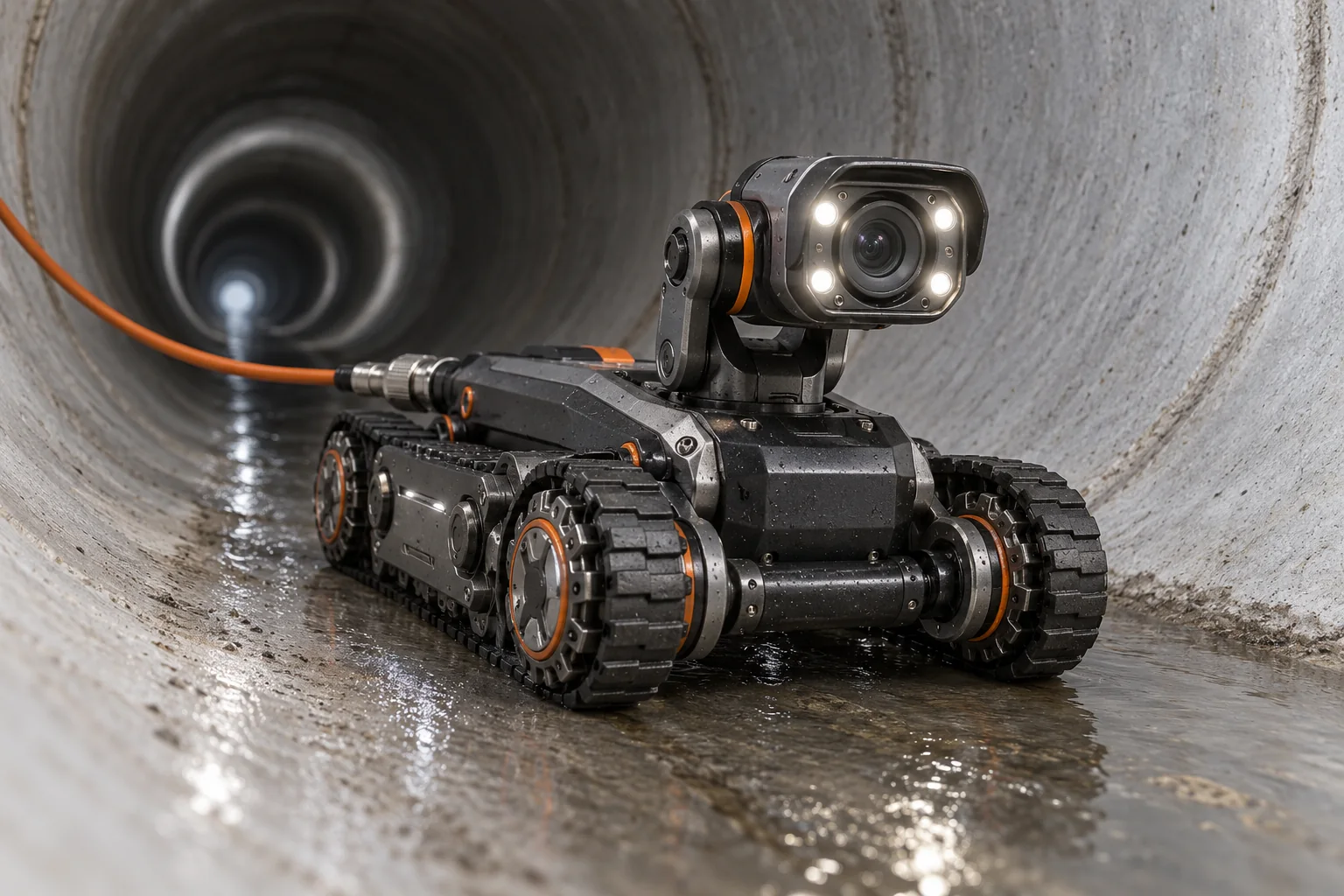
PipeCrawler AI
Autonomous/semi-autonomous inspection of sewer or industrial pipe with defect indexing by distance.
Designed for Utilities. Source profile: Idea / Research; feasibility: Medium; prototype complexity: High.
Project text and technical scope
Problem addressed
Current Utilities workflows often depend on manual checks, disconnected devices and delayed evidence.
Product vision
Autonomous/semi-autonomous inspection of sewer or industrial pipe with defect indexing by distance.
Hardware platform
Pipe crawler + pan-tilt camera + distance encoder
Sensors and inputs
Video, distance, inclination
AI and software
Crack/blockage/joint defect CV
User workflow
Utilities use the device in-field; the system captures data, analyses it, requests human confirmation where needed and records the outcome.
Edge processing
Run latency/privacy-critical inference on device/edge; use server for fleet analytics, RAG, orchestration and reporting.
Connectivity
Tether
Mobile experience
Device pairing, live status, guided workflow, alerts, evidence review, offline sync and user actions.
Operations console
Fleet/device map, live events, health, incident queue, analytics, reports, configuration and audit history.
Safety and compliance
Confined-system safety and sanitation.
Operational value
Robot + software; value comes from measurable safety, traceability, downtime reduction or workflow automation.
Security and privacy
Secure device identity, encrypted transport/storage, RBAC, audit logs, minimum necessary personal data and configurable retention.
Commercial model
Robot + software
Differentiation
Creates structured defect timeline automatically.
Demo scenario
Show a realistic operator using PipeCrawler AI; capture sensor/device event → AI analysis → alert/recommendation → human action → report.