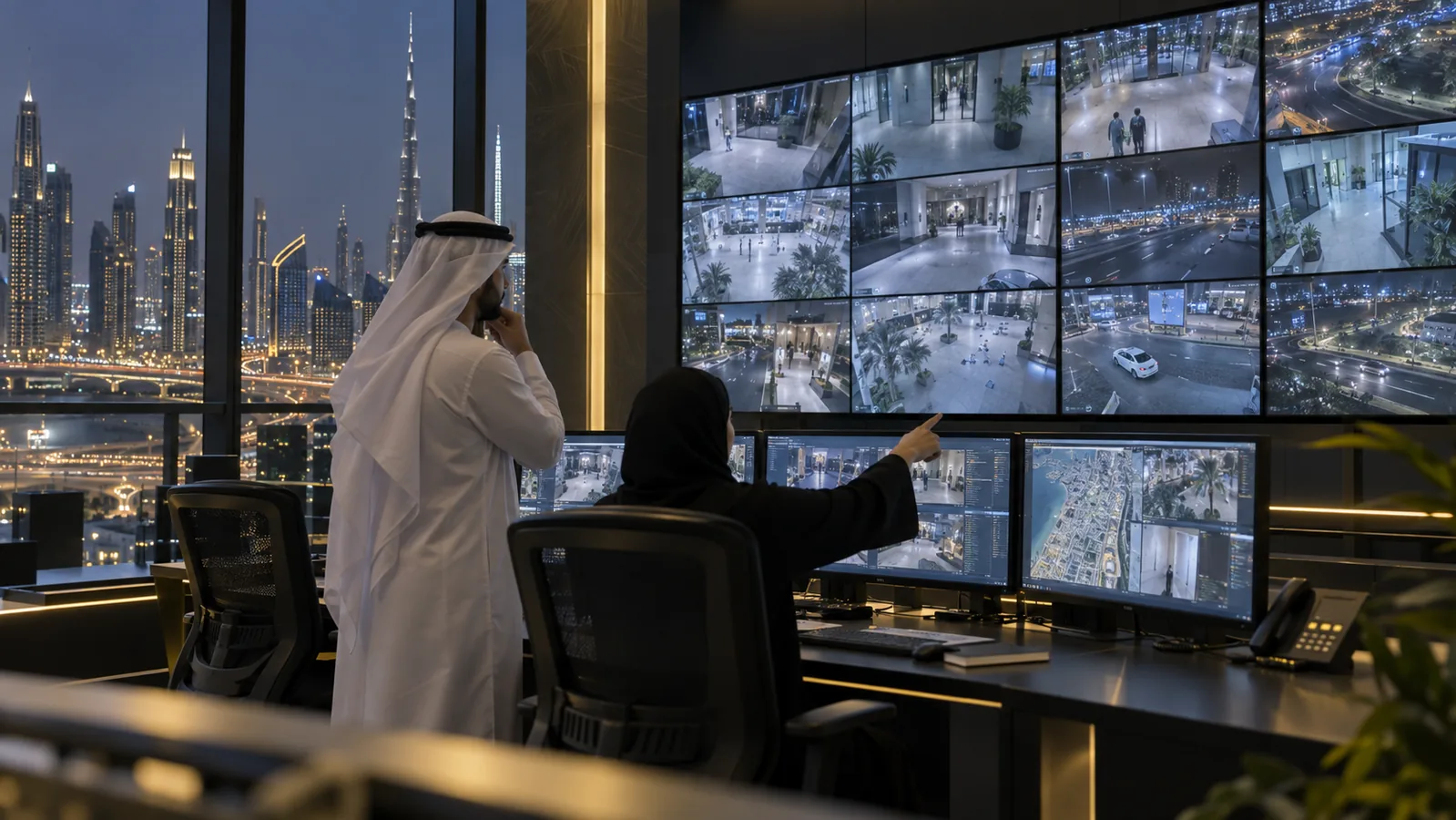
AI CCTV vs Traditional CCTV: What Changes and What Doesn’t
Short answer: traditional CCTV records video for people to watch live or review after an incident. AI CCTV adds video analytics that watch every stream continuously, raise alerts on defined events (intrusion, missing PPE, loitering, vehicles, crowding) and let operators search footage by attributes instead of scrubbing through hours. The cameras, recording and retention stay; the AI changes how much of the footage anyone actually uses. It also adds compute, tuning and governance work.
Request a Video Analytics Assessment
Side-by-side comparison
| Criteria | Traditional CCTV | AI CCTV (video analytics) |
|---|---|---|
| What it does | records; operators watch live walls or review later | detects defined events, alerts, and indexes footage for search |
| Operator workload | grows with every camera added | alerts reduce watching; operators handle events |
| Incident response | often after the fact, from recordings | during the event, if the alert and escalation are set up |
| Finding footage | manual review by time and camera | search by object, attribute, zone or time |
| Camera requirements | coverage and retention | also resolution, angle, lighting and frame rate suited to each detection |
| Infrastructure | cameras, network, NVR/VMS, storage | the same, plus GPU compute at the edge or on servers |
| Cost | lower up front | higher: analytics licences or software, compute, tuning |
| Main risk | missed events because nobody was watching | false alarms if not tuned; privacy and governance of the analytics |
| Best use | evidence and deterrence at low risk sites | large estates, safety compliance, perimeters, busy control rooms |
| Limitation | people can’t watch every screen | only detects what it was set up and tested for |
Can AI run on existing cameras?
Often, yes. Many analytics run on streams from existing IP cameras through the VMS, as long as each camera’s resolution, angle and lighting suit the detection. A camera placed for general overview may not see enough detail for PPE or number plates. An assessment checks each view against each use case before anything is bought. See AI CCTV integration and CCTV blind-spot assessment.
False alarms and tuning
AI CCTV is only as useful as its alerts. Lighting changes, shadows, rain, reflections and busy scenes cause false alerts, and too many make operators ignore them. Plan for a pilot with measured alert quality per camera and rule, and for tuning afterwards (reducing video analytics false alerts).
UAE considerations
- SIRA (Dubai): CCTV systems must meet SIRA requirements for coverage, recording, storage and retention. Analytics add to a compliant system; they don’t replace it. Swedish Technology designs analytics around those requirements and works with your SIRA-approved installer. We are not a SIRA-approved installer ourselves.
- Storage and retention: analytics don’t reduce the retention you must keep; plan storage for it (CCTV storage planning).
- Privacy and governance: decide which detections are used, who sees alerts and how long analytics data is kept.
- Hosting: analytics can run on-premises or at the edge, so video doesn’t leave the site.
Common mistakes
- Buying analytics licences before checking whether the camera views support the detections.
- Enabling every rule on every camera and flooding operators with alerts.
- Treating AI as a substitute for a compliant CCTV design.
- No escalation process, so alerts arrive but nobody acts.
- No measured pilot, so nobody knows whether alerts are right.
Related
AI video analytics in the UAE · RAQEEB AI surveillance · Computer vision solutions · Reducing false alerts · CCTV storage planning · All comparisons
FAQ
What is the difference between AI CCTV and normal CCTV? Normal CCTV records video for people to watch. AI CCTV analyses the video automatically, raises alerts on defined events and makes footage searchable.
Do I need new cameras for AI CCTV? Not always. Many analytics use existing IP cameras if the view, resolution and lighting suit the detection. Some use cases need new or repositioned cameras.
Does AI CCTV replace security guards or operators? No. It changes their work from watching screens to handling alerts and incidents.
How accurate is AI CCTV? It depends on the detection, the camera view and the conditions. Measure it in a pilot on your own cameras rather than relying on vendor figures.
Is AI CCTV allowed in Dubai? The CCTV system itself must meet SIRA requirements. Analytics are designed around those requirements and deployed with a SIRA-approved installer.
Can the analytics run on-premises? Yes, at the edge or on on-premises servers, so video stays on site.