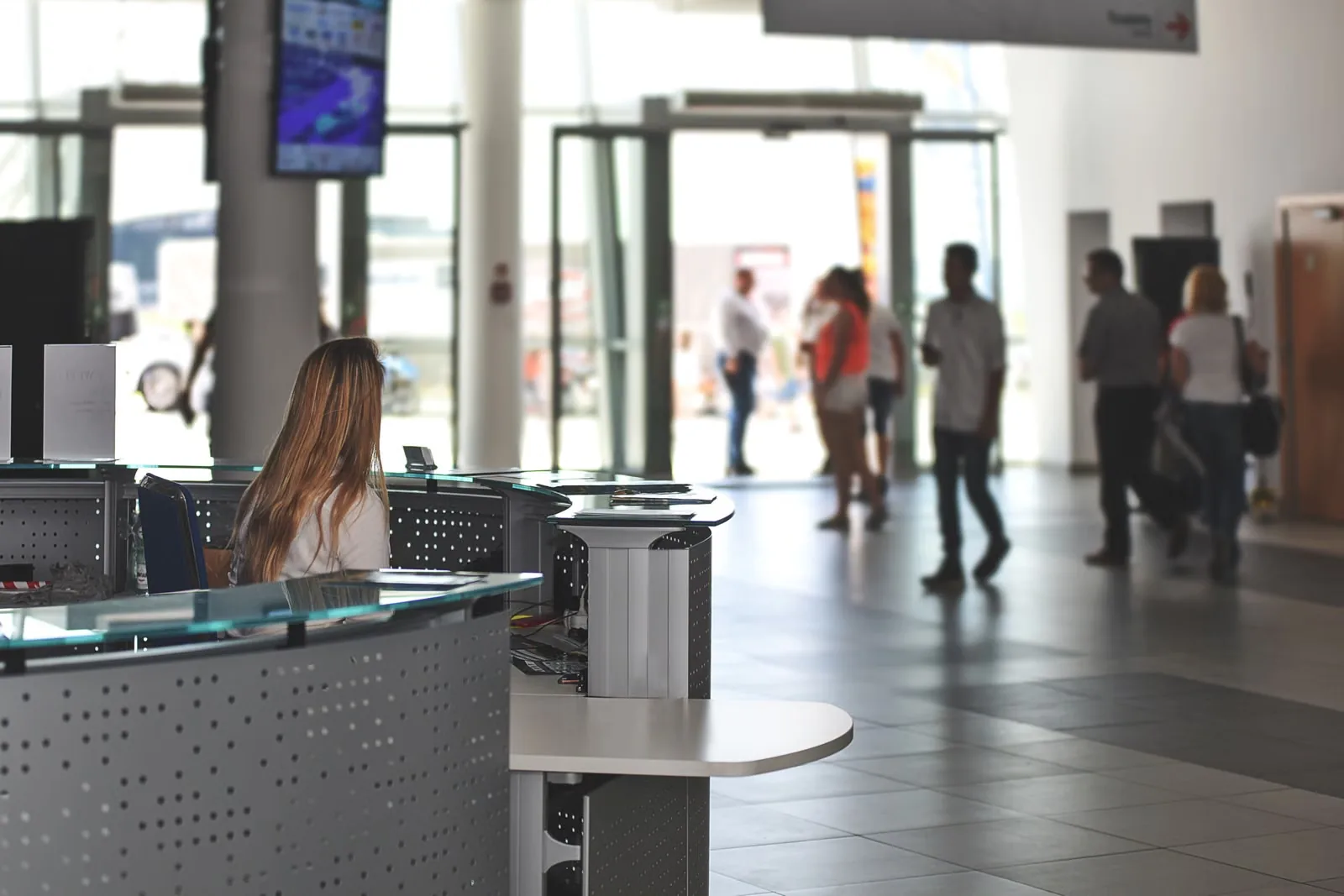
An office visitor management system handles the corporate visitor lifecycle: the host pre-registers the visitor, the visitor checks in at a kiosk or reception in seconds, any required NDA or site rules are accepted and recorded, a badge or mobile pass is issued with temporary access entitlement, and the host is notified through the channel they actually read. It also produces the one thing a paper book never did — an accurate list of who is in the building right now.
Judged on three things: how long a visitor stands in the lobby at 09:00, whether the host actually gets the notification, and whether the evacuation list is true.
- Pre-registered check-in in seconds at the peak
- Host notified by Teams, SMS, email or WhatsApp
- NDA and site rules accepted and recorded
- A live, true evacuation list

What actually happens in a corporate lobby
The office visitor problem is concentrated into about forty minutes. Between 08:45 and 09:25 a lobby designed for a steady trickle receives interview candidates, a delivery, three consultants and a board member, all needing the same receptionist. The queue is not caused by the process being slow in general — it is caused by the process being the same length for everyone, including the visitor the host registered a week ago.
The second failure is notification. The receptionist calls the host's desk phone, which nobody answers because the host is in a meeting; the visitor sits in the lobby for twelve minutes. The third is the record. Asked during a fire drill who is in the building, most offices produce a signing-in book with no departure times, so the list grows all day and is never true — which is the one moment it needed to be.
- The 09:00 peak, not the daily total, is what makes a lobby feel badly run.
- Pre-registered visitors go through the same process as walk-ins, wasting the preparation.
- Desk-phone notification fails precisely when the host is in the meeting they booked.
- A signing-in book with no exit times produces an evacuation list that is always wrong.
- In a multi-tenant tower, building reception and tenant reception each hold half the story.
Solution overview
Swedish Technology separates the visitor types so the fast case is fast. A pre-registered visitor scans a QR at a kiosk and is checked in within seconds, with their badge printed and the host notified before they reach the desk. Walk-ins and exceptions go to the receptionist, who now has time for them. That split is what removes the 09:00 queue, and it costs nothing except asking hosts to pre-register.
Notification goes to the channel the host reads rather than the one on their business card — in most UAE offices that is Microsoft Teams or WhatsApp, not a desk phone — with escalation to a delegate if there is no response. NDAs, site rules and safety briefings are presented and recorded at check-in, and temporary entitlement is written into the access-control system already installed so a visitor reaches the right floor and no other. Check-out closes the visit, which is what makes the on-site list usable in a drill.
How the solution works
- 1Host pre-registers From Outlook, Teams or the web, usually as part of booking the meeting. The visitor receives a QR pass, directions and parking information before they travel.
- 2Arrival The pre-registered visitor scans at a kiosk and is checked in in seconds; walk-ins and exceptions go to the receptionist rather than joining the same queue.
- 3Verify where required Emirates ID or passport captured where the site requires verified identity — restricted floors, data rooms, government-linked work — not for every visitor.
- 4Accept and issue NDA, site rules or a safety briefing presented and recorded; a badge prints or a mobile pass issues with entitlement scoped to the floors the visit needs.
- 5Notify the host Teams, SMS, email or WhatsApp, with escalation to a delegate or the team's assistant when the host does not respond within a set interval.
- 6Check out Closed by scan, by lift-lobby exit or by an end-of-day rule, so the on-site list is accurate enough to use when the alarm sounds.
Key capabilities
Reference architecture
The design constraint is the peak, not the volume. Everything on the critical path between a visitor arriving and a badge in their hand runs locally.
Deployment options: Cloud or on-premise. Government-linked and regulated tenants commonly require in-country hosting; free-zone entities in DIFC or ADGM should also confirm their own data protection regime at design stage.
Hardware options
Sized for the 09:00 peak. A lobby that is comfortable at 14:00 tells you nothing about whether it works.
| Device | Where it is used | Selection notes |
|---|---|---|
| Check-in kiosk | Lobby, in the visitor's line of sight from the entrance | Absorbs the pre-registered majority. Placement matters: a kiosk the visitor does not see on entry is a kiosk they walk past on their way to the desk. |
| Reception tablet | The desk | For walk-ins, exceptions and anyone who wants a person. The staffed path is never removed — it is what the kiosk frees up. |
| Badge printer | At the kiosk and the desk | Where the building requires a visible pass. Many offices with speed gates do not, and a mobile pass is faster and cheaper. |
| Emirates ID / passport reader | Where identity must be verified | For restricted floors, data rooms and regulated work — not for routine meetings, where it adds time for no risk reduction. |
| Speed gates integration | Lobby line | Visitor entitlement presented to the existing gates so visitors and staff use one set of doors and one audit trail. |
Swedish Technology supplies and integrates equipment from established manufacturers; the lobby specification follows the arrival profile and the building's existing gate line.
AI capabilities
Used to reduce typing and to make the lobby predictable rather than reactive.
- Host name matching — Fuzzy matching against the directory so a visitor who half-remembers a name still finds their host, including across Arabic and Latin spellings of the same person.
- Document OCR — Extracts details from a passport or Emirates ID with a confidence score, routing uncertain reads to reception rather than writing a wrong record.
- Arrival forecasting — Predicts lobby load by hour from booked meetings and historical patterns, so reception is staffed against the day rather than against a fixed rota.
- Repeat visitor recognition — Recognises a returning visitor so their record is reused, which is what makes a regular consultant's fifteenth visit faster than their first.
Integrations
An office visitor system is mostly integration. These can be designed and built within project scope.
| System | Integration point & data exchanged | Direction |
|---|---|---|
| Microsoft Entra ID / Active Directory | Host directory, delegates and notification addresses sourced from the corporate directory, so a leaver stops appearing as a selectable host without anyone doing anything. | inbound |
| Microsoft Exchange / Outlook / Teams | Visitors invited as part of the meeting invitation, and the host notified in Teams — the channel most UAE offices actually read. | bi-directional |
| Access control | Temporary entitlement per floor issued for the visit and revoked at check-out, using the doors and gates already installed. → Employee & Visitor Access Control Integration | outbound |
| Meeting room booking | Check-in linked to the room booking, so an unclaimed room can be released and the visitor directed to the right floor. → Meeting Room Visitor Check-In | bi-directional |
| HR / Oracle / SAP | Contractor and supplier validation where a visit is commercial rather than social, checked against a real supplier record. → Contractor Access Management System | inbound |
| CAFM / building management | Visitor volumes shared for cleaning, catering and cooling schedules, and contractor arrivals linked to work orders. → Facility Management | outbound |
The integrations above are designed and implemented within project scope using vendor APIs, webhooks or standard connectors. They do not imply partnership, certification or endorsement by the system owner unless stated on that vendor's official pages.
Dashboards & analytics
- In the building now — Visitors on site by host, floor and category — the list used at a muster point, and the reason most offices buy this.
- Lobby performance — Check-ins per hour against the arrival forecast, average time to badge, and the proportion falling back to the desk.
- Host responsiveness — Time from notification to host acknowledgement, and escalation rate — the number that explains lobby waiting far better than reception staffing does.
- Compliance — NDA and site-rule acceptance, identity verifications performed, watchlist matches, and the full visit audit trail.
Security & deployment
Visitor data is scoped by role: a receptionist sees today's expected arrivals, a host sees their own visitors, security sees the building and the audit trail. Kiosks run locked down with session timeouts that clear the screen, so one visitor never sees the previous visitor's details — the failure a paper book makes unavoidable. Identity documents are reduced to a verified attribute rather than retained as images by default, and the lobby edge holds an encrypted cache so check-in and printing continue through a network outage.
Data privacy
An office collects personal data about people who are not its employees and often not its customers, so proportionality is the governing question. The standard configuration collects name, company, host and timestamps; identity documents are captured only where the site genuinely requires verification and are held as a verified attribute rather than an image. Visitor photographs are optional and disabled where an organisation does not want them.
Under UAE Federal Decree-Law No. 45 of 2021 the occupying organisation is the controller for its own visitors. In a multi-tenant tower this needs stating explicitly: the building operator is controller for lobby and common-area data, each tenant for its own visitors, and the boundary belongs in the tenancy agreement rather than in an assumption. Entities in DIFC or ADGM are additionally subject to those free zones' own data protection laws, which is checked at design stage.
Industry use cases
UAE & GCC considerations
The multi-tenant tower is the specific UAE pattern that catches most products out. A visitor arrives at a building reception operated by the landlord, then at a tenant reception on the floor, and both want a record. Designing that as one flow with two controllers — building operator for the lobby, tenant for their floor — avoids the common outcome where the visitor signs in twice and neither party has a complete picture during an evacuation.
Practically, Arabic and English are both required on the kiosk, the printed badge and the notification, with Arabic names rendered correctly on thermal-printed badges. Emirates ID is the natural verification method where verification is genuinely needed, with passport OCR for visitors. Free zones matter: DIFC and ADGM entities fall under their own data protection laws rather than the federal PDPL alone, and government-linked organisations frequently require in-country hosting — both are deployment decisions to settle before selecting a platform.
Implementation approach
- 1Arrival profile Measure visitors by hour for a representative fortnight. Lobby design is decided by the peak, and almost every office underestimates it.
- 2Policy workshop Who may host, what identity verification applies where, which NDAs and rules are required, and what happens to an unaccompanied visitor for a host who does not respond.
- 3Directory and calendar integration Entra ID and Exchange connected so hosts, delegates and meeting invitations drive pre-registration rather than a separate step nobody does.
- 4Lobby fit-out Kiosk placement in the visitor's sightline, badge printing where needed, and speed-gate integration tested with real visitor credentials.
- 5Host adoption Pre-registration only works if hosts use it. Embedding it in the meeting invitation, rather than as a separate portal, is what makes that happen.
- 6Drill test Run an evacuation drill using the on-site list. This is the fastest way to find that check-out is not happening, and the cheapest time to find it.
Why Swedish Technology
- We split the fast path from the exception path, which is what actually removes the 09:00 queue.
- Notification goes where the host reads, with escalation — an unanswered notification is the same as none.
- The multi-tenant controller boundary is designed explicitly rather than discovered during an incident.
- Arabic and English on kiosk, badge and notification, with Arabic names printing correctly.
- We test the evacuation list in a real drill, because that is the number the system is ultimately bought for.
Limitations & prerequisites
- Pre-registration depends on hosts. Where adoption is low the kiosk sits idle and reception carries the same load as before, so host adoption is a change-management task, not a feature.
- Host notification cannot make a host respond. Escalation to a delegate mitigates it; nothing eliminates it.
- The on-site list is only as good as check-out. Buildings without exit gates need an end-of-day rule, and that rule makes the evening figure an estimate.
- In a multi-tenant tower, coverage depends on tenants participating. A tenant running its own separate process leaves a gap in the building-wide list.
- Watchlist screening is only as good as the list the organisation maintains.
- References to PDPL, DIFC and ADGM obligations are general guidance, not legal advice.
FAQ
A system that handles the corporate visitor lifecycle: the host pre-registers the visitor, the visitor checks in at a kiosk or reception in seconds, NDAs or site rules are accepted and recorded, a badge or mobile pass is issued with temporary access, and the host is notified through the channel they read. It also produces an accurate list of who is in the building.
By separating the fast case from the slow one. Pre-registered visitors self-check-in at a kiosk in seconds; walk-ins and exceptions go to the receptionist who now has time for them. The queue is rarely caused by the process being slow — it is caused by every visitor going through the same length of process.
Send it where they read. In most UAE offices that is Microsoft Teams or WhatsApp rather than a desk phone, and it should escalate to a delegate or team assistant if there is no acknowledgement within a set interval. Host response time is worth reporting — it usually explains lobby waiting better than reception staffing does.
Yes, and they should. Temporary entitlement is written into the installed access-control system for the floors the visit needs and revoked at check-out. That keeps one set of doors, one audit trail and no second credential technology to maintain.
As one flow with two controllers: the building operator handles arrival and lift-lobby access and is controller for common-area data; each tenant handles its own floor, its own rules and its own visitor data. Designing that explicitly avoids the usual outcome where a visitor signs in twice and neither party has a complete picture in a drill.
Rarely. Identity verification is appropriate for restricted floors, data rooms and regulated work; applying it to a routine meeting adds time at the peak for no meaningful risk reduction, and collects personal data with no purpose behind it. The policy should be set by area rather than applied uniformly.
Only if check-out happens. Where the building has exit gates it is automatic; where it does not, an end-of-day rule closes open visits and the evening figure becomes an estimate. We recommend testing it in a real drill early, because that is when the gap shows and it is cheap to fix then.
Yes — kiosk flows, printed badges, notifications and site rules all exist in Arabic and English, with RTL layout and Arabic names rendered correctly on thermal-printed badges. That last point is a font and encoding decision made at design time rather than discovered at go-live.
Discuss your site with an engineer
Tell us the venue, the expected visitor volume and the systems you already run. We reply with a technical view, a realistic scope and the next sensible step — a site survey, a working demonstration, or a full technical and commercial proposal.
Sources & evidence
- UAE Federal Decree-Law No. 45 of 2021 — Personal Data Protection Law — Governs collection, retention and cross-border transfer of visitor personal data in the UAE.
- ICP — Emirates ID — Issuing authority for the Emirates ID credential read at registration.
- DIFC Data Protection Law No. 5 of 2020 — Separate data protection regime for entities inside the DIFC free zone.
Vendor and product names are trademarks of their respective owners; references are for technical context and do not imply partnership, certification or endorsement.