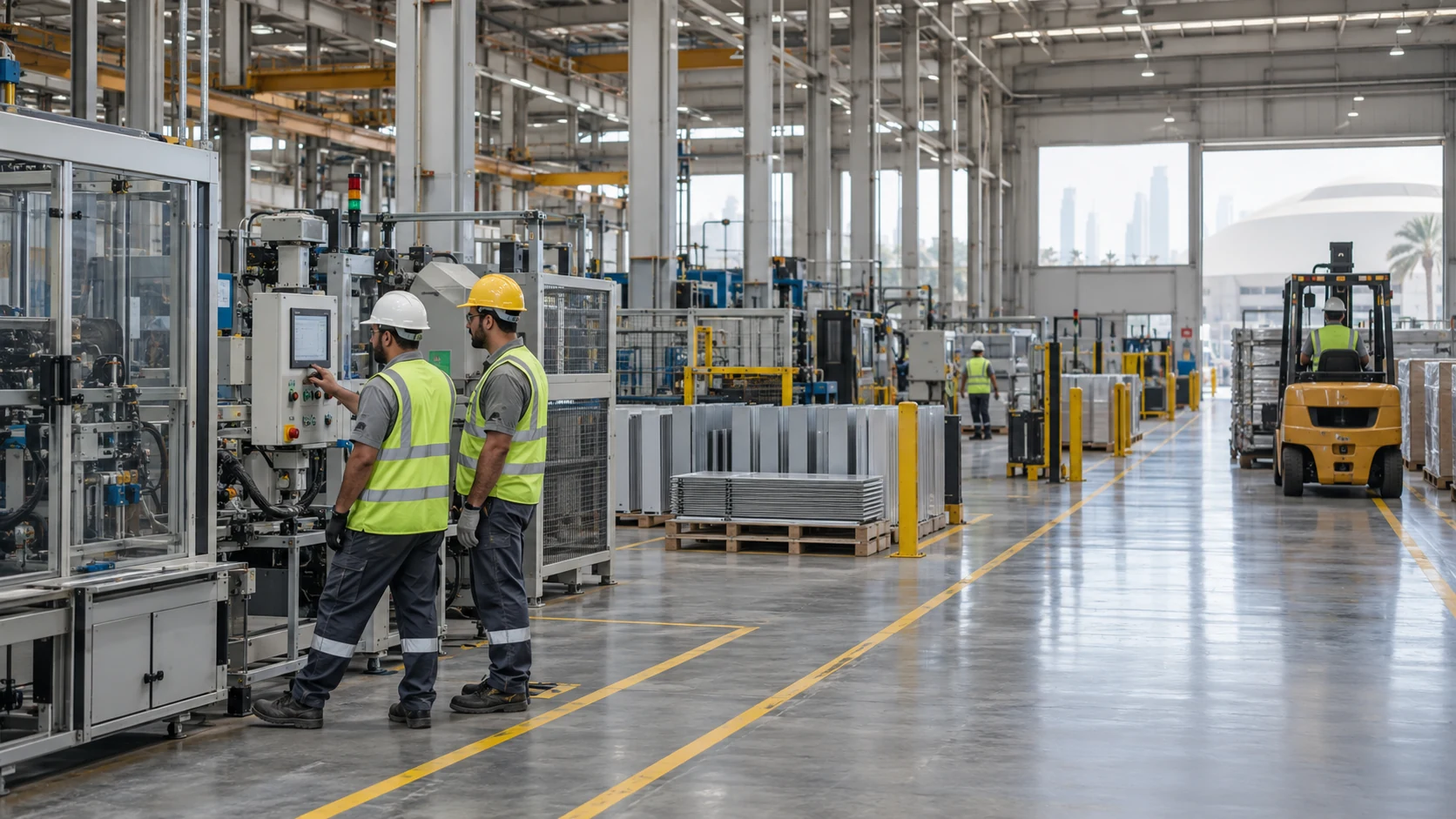
In short: In this scenario, video analytics run on the plant's existing cameras to detect missing PPE, entry into restricted zones and unsafe forklift-pedestrian proximity, and send alerts with a short clip to the shift supervisor instead of relying on occasional walk-rounds.
Tell Us Your Requirement Talk to an engineer
This is a solution scenario: it shows how a typical deployment works for this kind of organisation. It is not a description of a specific client project, and it contains no client results.
Scenario at a glance
| Typical organisation | Manufacturing plant |
|---|---|
| Sector | Industrial / manufacturing |
| Problem | Safety rules checked by occasional walk-rounds; incidents found after the fact |
| Core technologies | Existing IP cameras, video analytics on edge or on-premises servers, alerting, dashboards |
| Hosting | On-premises, UAE-region private cloud or hybrid, depending on data rules |
The situation
Safety rules on a large plant floor are usually enforced by supervisors on walk-rounds, which cover only part of the site at any time. Near misses go unrecorded, and incident reviews depend on searching hours of recordings.
How it works
- Each camera view is checked against the detections it should support (angle, resolution, lighting).
- Rules are set per zone: PPE requirements, restricted areas, vehicle lanes, time windows.
- Analytics run on the video streams and raise alerts with a snapshot or clip.
- Supervisors acknowledge and act; every event is logged for trend analysis.
- Rules and thresholds are tuned after a pilot to keep false alerts low.
What it detects
- Helmet detection
- Safety vest detection
- Safety shoe requirements checks
- Restricted area intrusion
- Person-down detection
- Worker proximity to machinery
- Forklift/pedestrian proximity
- Smoke detection
- Crowd formation
- Unsafe pathway usage
- Blocked emergency exit
- Unauthorized access
- Loitering
- Object left behind
Technology stack
- Existing CCTV cameras
- AI inference servers
- GPU acceleration
- Video management integration
- Event engine
- Dashboard
- Incident workflow
- Evidence clips
- Rule configuration
- Notification system
What a pilot should measure
Results depend on the site. These are the measures a pilot should agree up front and report honestly:
- Alert precision per rule and camera during the pilot
- Time from event to supervisor acknowledgement
- Recorded near misses per month (usually rises at first)
- Share of alerts closed with a corrective action
UAE considerations
- Run analytics on-premises or at the edge so video stays on site.
- Decide in advance who sees alerts and how long analytics data is kept.
Questions buyers ask
Does it need new cameras?
Often not. Existing IP cameras can be used where the view and resolution suit the detection; some zones may need new or repositioned cameras.
What about false alarms?
They are the main risk. A measured pilot per camera and rule, followed by tuning, keeps alerts useful to supervisors.
Does it identify individual workers?
Not necessarily. PPE and zone rules work on people as objects; whether identity is used at all is a governance decision.
Related
Computer vision solutions · Site safety computer vision · AI PPE detection · All solution scenarios
Planning something similar?
Tell us about your site and systems. We will scope a pilot for computer vision safety monitoring and say plainly what it can and cannot prove.
Tell Us Your Requirement